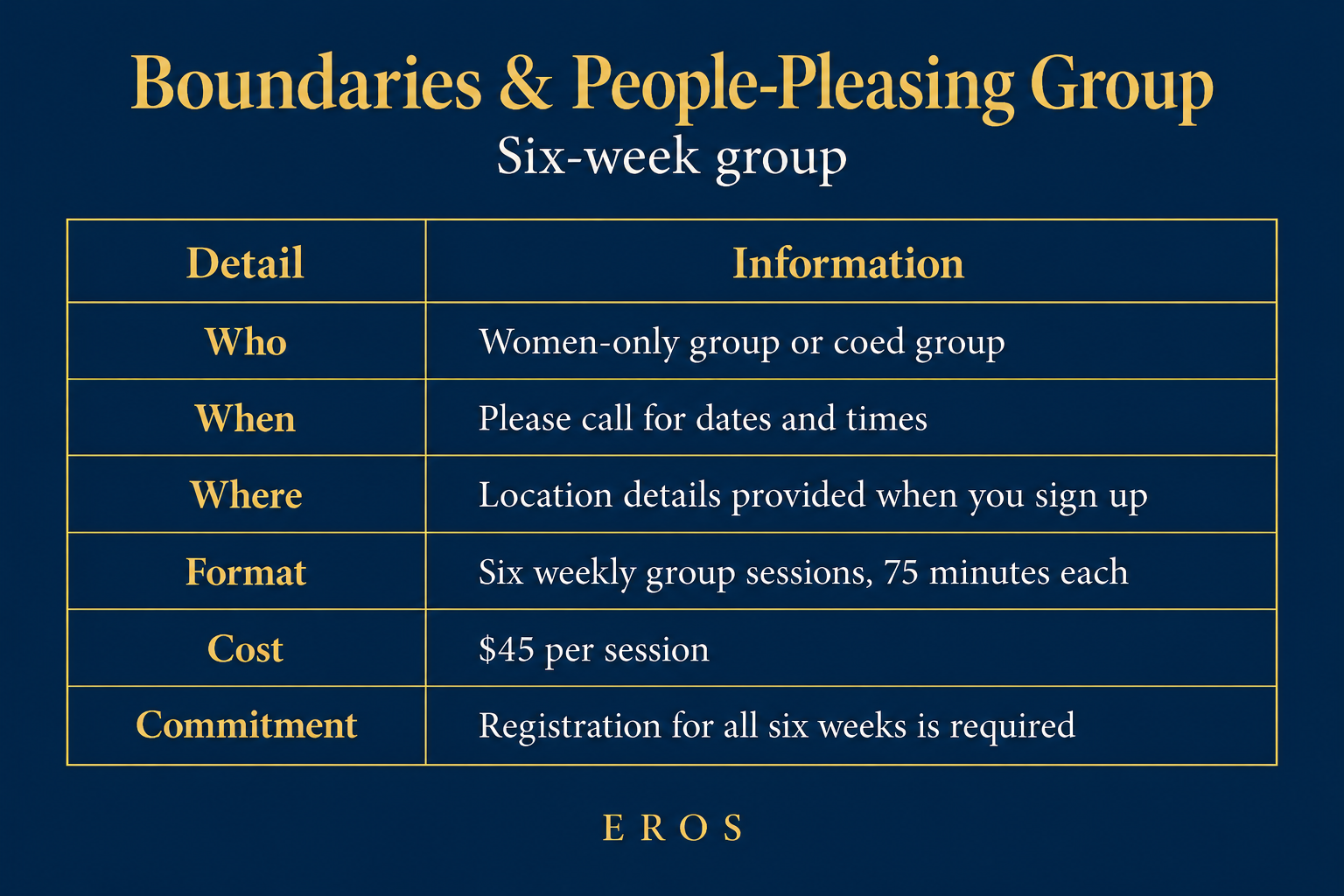
Boundaries & People-Pleasing Help in Show Low & the White Mountains
You say yes when you mean no. You smooth things over so no one is upset. You know everyone else's needs and have lost track of your own. People-pleasing often starts as a smart way to stay safe in childhood, and becomes exhausting in adulthood. At EROS, you can learn to set boundaries with warmth, without guilt, in a six-week group or in individual therapy in Show Low and the White Mountains.
Signs you might be a people-pleaser
You apologize for things that aren't your fault.
Saying no makes your heart race or your stomach drop.
You feel responsible for other people's moods.
You give until you're depleted, then feel resentful or invisible.
You're not sure what you actually want, because you've always focused on others.
You were the "responsible one" growing up, caring for siblings or even parents.
Boundaries aren't walls
A boundary isn't pushing people away. It's telling them how to love you well. Healthy boundaries often make relationships closer, not colder, because people finally know where you stand.
The six-week Boundaries & People-Pleasing Group
What you'll practice
Understanding where your people-pleasing came from
Noticing the body signals that tell you a boundary is needed
Saying no kindly and clearly
Handling guilt, pushback and other people's disappointment
Boundaries with partners, parents, adult children and at work
Building a life that includes your own needs
Prefer one-on-one?
Individual therapy lets us go deeper into the family patterns and nervous system responses behind people-pleasing, at your own pace. [Therapy for Women →] [Therapy for Men →]
Boundaries in small-town life
In the White Mountains, you may see your family, coworkers and neighbors everywhere, from church to the grocery store. Boundaries can feel harder when everyone knows everyone. We'll practice boundaries that fit real life in a close-knit community.
Boundaries questions
Is the group therapy or a class? The group is led by me, a licensed clinician, and combines education with guided practice.
Do I have to share in the group? You share only what feels comfortable. Many people learn a lot just by listening at first.
Why the six-week commitment? The group builds week by week, and consistent members help everyone feel safe.
Will I run into people I know? In a small community, it's possible. Everyone agrees to keep what's shared in the group confidential.